
Harlem and Queens Hand New York a Black Abstraction Season
The Studio Museum's "Geometries" is up, MoMA PS1's "Hard Art" opens Nov. 5, and ten artists sit in both. This fall, Black abstraction owns the map.
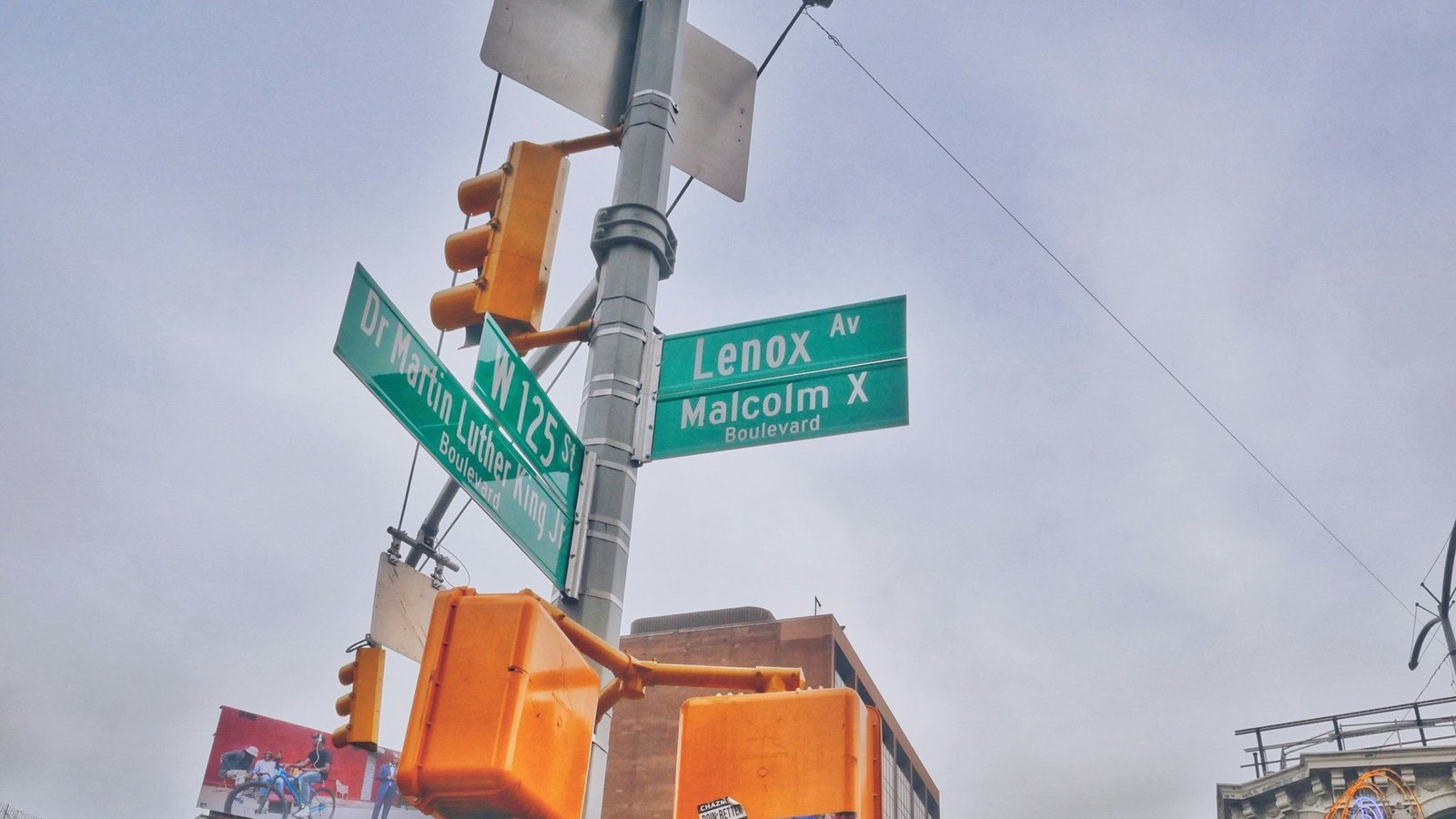
Lenox Avenue and 125th Street, steps from the Studio Museum in Harlem. Photo: Kaysha / Unsplash.
For a long time, abstraction got sold to the public as the art form with no address. No neighborhood, no body, no history. Just color and line floating above it all. This fall, New York is putting that idea on trial, and the verdict is coming from 125th Street and Long Island City.
Uptown, the Studio Museum in Harlem has "Geometries" on its walls. Next Thursday, Nov. 5, MoMA PS1 in Queens opens "Hard Art," a show built around abstract painting by Black artists in the United States from 1969 to today. Two institutions, two boroughs, one argument: Black artists didn't just participate in abstraction. They bent it, stretched it and filled it with meaning that the textbooks kept leaving out.
From where we sit in Harlem, that is not a niche art story. That is a New York story.
What's on the wall uptown
"Geometries" is curated by Thelma Golden, the Studio Museum's director and chief curator, with curatorial assistant Simon Ghebreyesus. The museum lists 30 artists, a lineup that runs from foundational names like Alma Thomas, Norman Lewis and Jack Whitten to living heavyweights like Julie Mehretu, Stanley Whitney and Adam Pendleton.
The museum frames geometry as more than math. In its telling, lines and shapes can carry emotion, identity and sacred knowledge. Some of the artists work inside the Western tradition of geometric abstraction. Others push back on its claim to purity by pulling from African artistic traditions, or by wrestling with what modernism has demanded of Black artists. The source material reads like a New York block: city maps, West African textiles, patterned flowers, even sound vibrations.
The line that sticks with us comes from the late painter Al Loving, quoted on the museum's exhibition page: "even a box can be a self-portrait." That is the whole show in seven words. A square is never just a square when the person drawing it has been told where they can and cannot stand.
The building matters too. The Studio Museum reopened its new 82,000-square-foot home on West 125th Street in November 2025 after a seven-year closure, according to Time Out New York. In September, Beyoncé marked her birthday by announcing a $2 million gift to the museum. Sunday admission is free.
What opens in Queens next week
"Hard Art" is the bigger swing in scale. MoMA PS1 says the show brings together more than 40 artists across three generations, placing paintings by artists who rose to prominence in the 1970s next to recent work in sculpture, video, sound and painting. Connie Butler, PS1's director, organized it with curatorial associate Sheldon Gooch. It runs through March 2027.
The historical roster is serious: Frank Bowling, Ed Clark, Barbara Chase-Riboud, Melvin Edwards, Howardena Pindell, Senga Nengudi, Sam Gilliam, David Hammons, Raymond Saunders. The newer voices include Aria Dean, Torkwase Dyson, Nikita Gale, Carolyn Lazard and Eric N. Mack, whose solo show at Paula Cooper Gallery in Chelsea just closed.
The title has roots. PS1 says it comes from painter Peter Bradley's description of "The DeLuxe Show," an exhibition that used abstraction's perceived difficulty to pull viewers into closer looking. The museum also ties "Hard Art" to "Afro-American Abstraction," a show curated by April Kingsley at PS1 back in 1980. So this is not a first conversation. It is a return visit, 46 years later, with a lot more people in the room.
The organizers say the cross-generational pairings "emphasize the enduring relevance and increasing urgency of abstraction in shaping the current political imaginary." Translation for the group chat: these paintings are not neutral, and they never were.
Ten names, two boroughs
Here is the detail that turns two good shows into one big story. By our count from the museums' own artist lists, ten artists appear in both exhibitions: Torkwase Dyson, Cynthia Hawkins, Daniel LaRue Johnson, Jennie C. Jones, Caroline Kent, James Little, Al Loving, Julie Mehretu, Adam Pendleton and Jack Whitten.
Nobody announced this as a joint project. That is what makes it interesting. When two of the city's most important institutions independently land on many of the same artists in the same season, it tells you where the canon is moving. The market, the academy and the museum walls are all catching up to what artists and Black collectors have known for decades.
It also gives New Yorkers a rare chance to see the same artist in two different conversations. Whitten among the geometry thinkers in Harlem, then Whitten in a lineage of Black abstraction in Queens. Same hands, different framing. That is a masterclass in how curators shape what we see, and it costs very little to take it. PS1 made admission free in January 2026, which, according to MoMA, makes it the largest free museum in New York City.
Why this matters to the culture
There is an old habit in art writing of treating Black artists as storytellers first and form makers second. Figure, portrait, narrative: that is where the spotlight usually lands. Abstraction got coded as somebody else's territory. These two shows say no, loudly.
For young artists in the Bronx, Washington Heights or Flatbush who paint shapes instead of faces, this season is permission. It says your square can be a self-portrait. It says the grid can hold your grandmother's quilt pattern, your block's subway map or the bass line coming out of a car on Lenox. It says you belong in the room where they decide what art history is.
And the Studio Museum is backing that up with its own pipeline. Its current residency show, "A sustained becoming," features new work by Derriann Pharr, Simonette Quamina and Taylor Simmons, the first cohort to work in the museum's new J. Bruce Llewellyn Artist in Residence Center. That is the long game: not just hanging legends, but building the next ones on 125th Street.
The Den's take
Do both shows, and do them in the same week if you can. Start in Harlem on a free Sunday, sit with the geometry, then take the train to Queens after "Hard Art" opens and watch the same names speak a different language. Bring somebody who says they "don't get" abstract art. That person is exactly who these exhibitions are for.
New York has been arguing about who owns abstraction for 50 years. This fall, Harlem and Queens are settling it in public.
Your turn
Which artist in these two shows should every New Yorker know by name, and why? Tell us.
Follow @theinnovatorsden.
Sources: Studio Museum fall season · Studio Museum: Geometries · Time Out New York · MoMA press: Hard Art · MoMA PS1: Hard Art · MoMA PS1 50th anniversary (PDF) · Alexander Gray Associates · Two Coats of Paint