
One Year After Melissa, Jamaica Is Open. It Is Not Finished.
A year after a Category 5 hit Jamaica, most hotel rooms are back and winter flights are loaded. Here is how to visit in a way that actually helps.
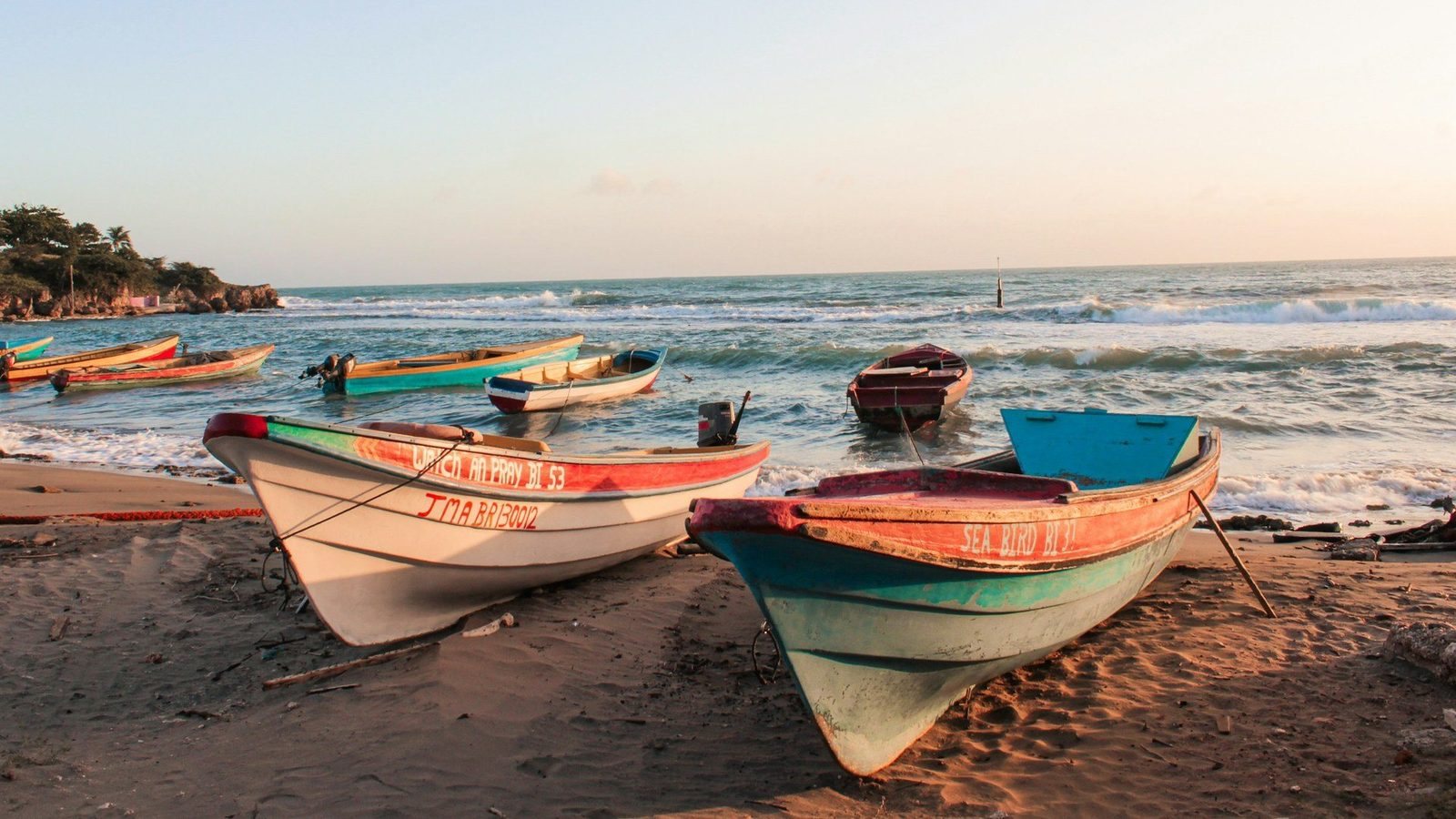
Fishing boats on Jamaica's south coast. Tourism money spread beyond the resorts goes furthest. Photo: Caspar Rae / Unsplash.
If you have people in Jamaica, you probably remember Oct. 28, 2025 by the phone. Calling home from Flatbush, Wakefield or Laurelton. Watching the radar. Waiting on a voice note that took too long to come.
That was the day Hurricane Melissa made landfall near New Hope, Westmoreland, as a Category 5 storm, according to Jamaica's Nationwide News Network. AccuWeather reports sustained winds of 185 mph at landfall, and notes that NOAA later upgraded the storm's winds over water to 190 mph, tying it for the strongest Atlantic hurricane on record. The World Meteorological Organization has since retired the name.
This week marked one year. The headline you will see in travel ads is simple: Jamaica is open. That is true. It is also not the whole story, and if you are from New York, you probably already know that.
The numbers behind "open"
Start with the good news, because there is real good news.
The Gleaner reports that about 90% of Jamaica's room stock is back in operation, with roughly 2,000 more rooms due in December and 3,000 more in early 2027. Visitors were welcomed back on Dec. 15, about seven weeks after the storm. Jamaica received about 2.3 million visitors from January through August, and airlines have committed more than 1.3 million winter seats. More than 80,000 hotel workers are back on the job.
Open Jaw, a Canadian trade outlet, put tourism earnings through the end of August at about $2.5 billion. But Tourism Minister Edmund Bartlett also told the outlet that arrivals were running 17% behind the same period in 2025.
Some big names are still rebuilding, and some are using the closure to reinvent. Open Jaw reported in September that three Sandals properties in a $200 million "Sandals 2.0" overhaul were scheduled to reopen in December, while seven Hyatt-affiliated properties in the Montego Bay and Rose Hall area had pushed their reopening to the first quarter of 2027. AccuWeather, citing the Associated Press, says 20 hotels remain closed as peak season begins.
Bartlett has a line for this moment, quoted by The Gleaner: "We are not bouncing back; we are bouncing forward."
"Reopening is not the same as recovery"
The other side of the anniversary deserves equal airtime, and it came from inside the industry. O'Brian Heron, president of the Jamaica Hotel and Tourist Association, told The Gleaner: "Reopening is not the same as recovery."
He is right, and the anniversary reporting shows why. Nationwide News lists St. Elizabeth, Westmoreland, Manchester, St. James, Trelawny and Hanover among the parishes with extensive damage. AccuWeather, citing The Gleaner, reports that 80 public schools were still operating in tents and on rotation. Citing the AP, it adds that 61% of insurance claimants had not received full settlements. The Gleaner notes that some tourism operators paid for repairs out of pocket to reopen and keep staff employed, and flags rising fuel prices, airlift and a proposed tax increase on tourism as risks to the comeback.
AccuWeather reports at least 45 deaths. The full human cost is larger than any count of rooms.
So both things are true. The resorts in the brochure are largely ready for you. Many of the communities that supply the cooks, drivers, housekeepers and craft vendors are still rebuilding their own homes.
Why this is a New York story
Jamaica is not a foreign destination for this city. It is a second home for a huge part of it. You hear it in the accents on the B41, smell it at patty spots from Gun Hill Road to Church Avenue, and feel it in dancehall that every New York party eventually plays.
That is why we think the Den audience has a different role than the average tourist. Last fall, a lot of the response from this city looked like barrels, wire transfers and donation drives. A year later, the most useful thing many of us can do is go. Tourism, according to TravelPulse Canada, accounts for more than 30% of Jamaica's GDP and roughly a third of its jobs. A booked room, a hired driver, a full table at a cook shop: that is recovery money in the hands of the people doing the rebuilding.
How to go, the Den way
This is not a guidebook. It is a mindset for the winter trip.
Check the property, not the island. "Jamaica is open" is an island-level statement. Your specific hotel, villa or guesthouse may be fully operating, partially open or mid-renovation. Ask directly before you book, and ask again a week before you fly.
Spread the money. All-inclusives have their place, especially for family trips. But build in at least one day where you eat at a local spot, hire a local guide or buy directly from an artisan. That is where a dollar travels furthest.
Look beyond the postcard strip. The Gleaner reports the government is pursuing new aviation facilities, including an airstrip in the Treasure Beach area, plus road upgrades along the north coast. The south and west took some of the hardest hits. If and when local operators there say they are ready, those are the trips that matter most.
Book flexible. Weather happens and recovery timelines move. Refundable rates and travel insurance are worth a few extra dollars. Read the policy, and talk to a licensed agent or insurer if you are unsure what is covered.
Bring the right energy. You are a guest in a country that just lived through what Nationwide News calls the most devastating hurricane to strike it since records began. Tip like you mean it. Be patient when something is still being fixed.
The Den's take
From where we sit in Harlem, we see travel as one of the most direct forms of economic solidarity there is. Hashtags fade. Bookings show up on payroll.
The anniversary headlines are right to be honest about what is unfinished. But the worst outcome for Jamaica's workers would be a winter where the diaspora and the culture lovers who know the island best stay home out of caution or guilt. The island is telling the world it is ready to host. The communities around the hotels are telling the world they are not done. Go anyway. Go with your eyes open, your money spread out and your respect fully packed.
Your turn
Have you been back to Jamaica since Melissa, or are you planning a trip this winter? Tell us where you are staying and what local spot everybody needs to support.
Follow @theinnovatorsden.
Sources: The Gleaner · AccuWeather · Nationwide 90FM · Open Jaw · TravelPulse Canada · Travel Weekly · PR Newswire