
Calabash, Humm and the West Village's New Art of Dining
A Jamaican-American pastry star and the chef behind Eleven Madison Park opened blocks apart in October. Both put art on the menu. Only one pours alcohol.
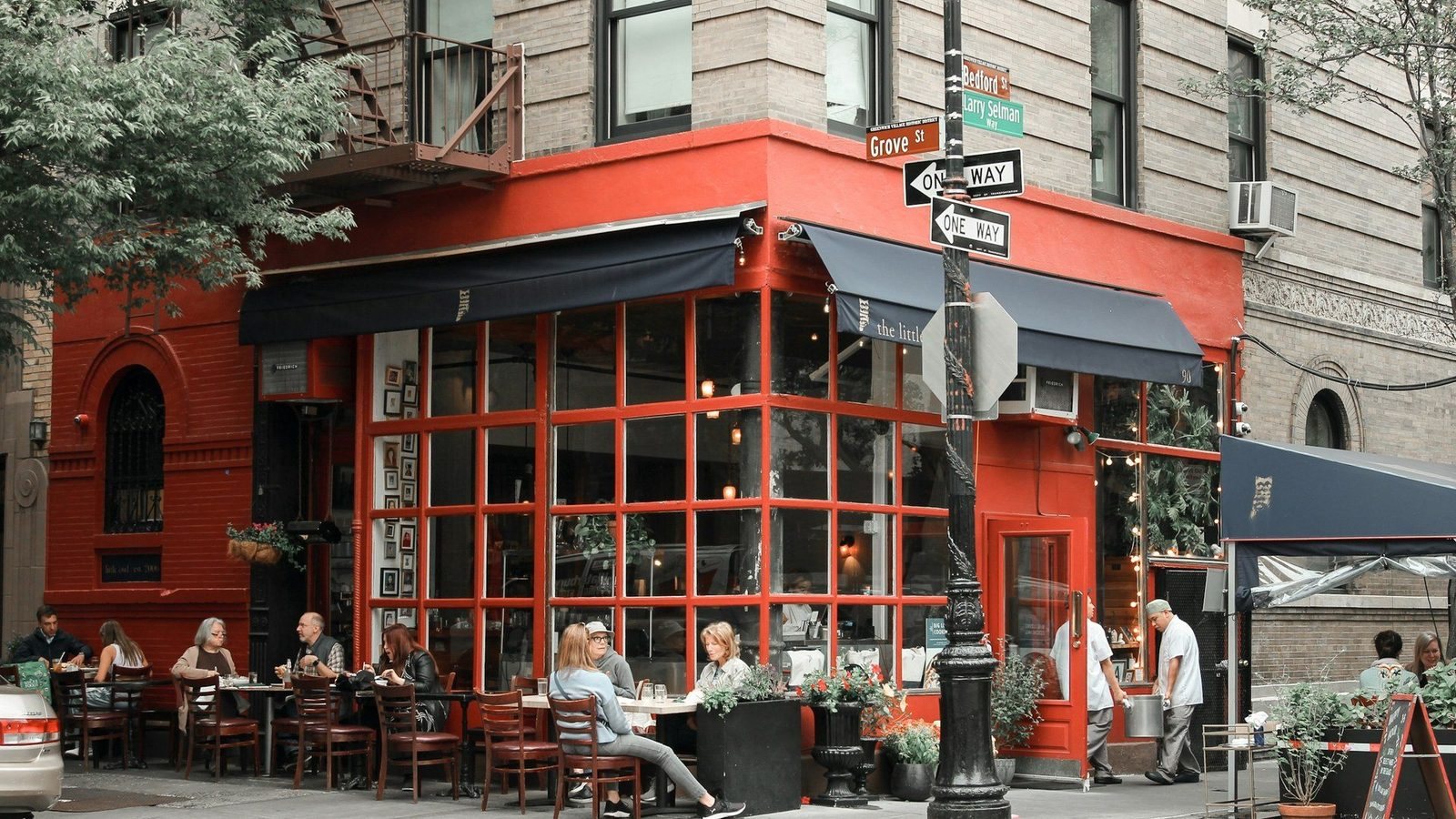
The West Village, where two of October's most talked-about openings sit blocks apart. Photo: Ana Lanza / Unsplash.
The West Village has always sold a certain fantasy. Brownstones, crooked streets, a candlelit table you could never get. This October, two new restaurants decided the fantasy needed a curator.
Within a few blocks of each other, a Jamaican-American pastry chef and one of the most famous chefs in the world each opened rooms where the art on the walls is as much the point as the food on the plate. One is a 30-seat Afro-Caribbean bakery and brasserie on Christopher Street. The other is a roughly 5,000-square-foot dining room on Hudson Street with a martini cart rolling between tables. They are very different restaurants. Read together, they say a lot about where New York dining is headed.
Calabash: the diaspora gets a gallery and a table
Calabash, at 183 Christopher St., is the first solo restaurant from Camari Mick. If you follow pastry in this city, you know the name. The Michelin Guide describes her as Jamaican-American and born in Pennsylvania. She trained in kitchens including Le Bernardin and Eleven Madison Park, ran pastry at the Michelin-starred Musket Room and became a partner at Raf's. Food & Wine named her a Best New Chef in 2024, and she has been a James Beard semifinalist for Outstanding Pastry Chef.
According to OpenTable, daytime service opened Oct. 2 and dinner followed on Oct. 16. Days run Thursday through Sunday, 8 a.m. to 4 p.m., with laminated pastries, fermented breads and cornbread pancakes with salted maple sabayon. Dinner is a single 6:30 p.m. seating on Fridays and Saturdays. The Infatuation lists it as a $175 five-course prix fixe.
The menu reads like a map of the African diaspora. Hoppin' John, the Southern Black New Year's staple, shows up as dolmas wrapped in collard greens. Suya, the Nigerian spiced grilled meat, becomes a steak au poivre on yaji spice with plantain fries. The Infatuation also describes pork belly with jollof rice under green mango chow-chow, and a dessert called Granny's Cheese Toast inspired by the chef's grandmother. Chef de cuisine Tajeh Porter runs the line with Mick, and the steak comes from Prince Abou's Butchery, a whole-animal shop.
Then there is the room. Gallerist Cierra Britton curated the art, which OpenTable describes as work by Black and brown artists and The Infatuation describes as work by BIPOC women. Dinner starts with about a half hour of canapés inspired by the paintings before guests sit down. The Infatuation's Molly Fitzpatrick called it "part gallery opening, part cocktail party, it's an unusual introduction to an extraordinary meal."
The toast without the alcohol
This is a column called Brindis, so here is the detail we cannot stop thinking about. Calabash does not serve alcohol. Whatnow reported the restaurant would pour mocktails instead, and The Infatuation says dinner opens with a nonalcoholic sparkling rosé. OpenTable lists house-brewed ginger beer, a sorrel fizz, adaptogenic drinks made with lion's mane mushrooms and coffee and tea from Africa.
That is a bold move at a $175 price point, where wine pairings usually carry a big share of the margin. It is also a smart read of who is actually at the table: not everyone at a celebration is drinking, and they deserve more than a soda with a lime. And sorrel and ginger beer are not trendy substitutes in Caribbean homes. They are the holiday table. Calabash is not asking anyone to give something up. It is saying the toast was never only about the alcohol.
Humm: a fine dining legend loosens his tie
A short walk away at 435 Hudson St., between Leroy and Morton, Daniel Humm opened Humm on Saturday, Oct. 10, in the former En Japanese Brasserie space, per Time Out. This is the chef behind Eleven Madison Park, the tasting-menu temple. Humm is something else: a dining room with the full menu, plus a bar and lounge with smaller menus, designed by Pierre Yovanovitch.
The art list reads like a museum wing. Time Out reports works by Louise Bourgeois, Rashid Johnson and Roni Horn, and a Francesco Clemente mural on the ceiling and in the private dining room. Humm told Food & Wine, as quoted by Time Out, "We want to show a different side of us."
The food centers on a wood-fired oven. The showpiece is a roast chicken for two from Amish farms in Lancaster, Pennsylvania, which The Infatuation lists at $108. A caviar-topped mini bagel runs $34. Time Out notes there is no red meat on the menu. And yes, there is a rolling martini cart.
The Infatuation's review, published Oct. 26, was mixed: it liked the chicken and liked a whole charred eggplant in a fried shell even more, but found the food not quite as impressive as the art. That is a fair tension for a room that leads with Clemente.
Why it matters, from where we sit
Here is the connection most people will miss. The Michelin Guide lists Eleven Madison Park among the kitchens where Mick trained. Years later, she and the chef whose name was on that door opened restaurants in the same neighborhood in the same month. One built a room for the African diaspora, a single seating, no bar. The other built a playground for a fine-dining legend, martinis on wheels. That is New York in one sentence. The ladder works sometimes, and when it does, people climb it and build their own house.
From Harlem, we watch the West Village with a little side-eye. It is not usually where Afro-Caribbean food gets the gallery lighting. Calabash changes that, and it does it on its own terms: Southern, West African and Caribbean flavors in conversation, art by Black and brown artists on the walls, a toast you can make whether you drink or not.
Both restaurants also bet on the same truth. In 2026, a meal in New York has to be a cultural event, not just dinner. Art, story, ritual, a reason to post. The difference is who gets to tell the story, and whose grandmother is on the menu.
Our take: if you have $175 and one Friday night, book Calabash, show up hungry and on time, and treat the canapé half hour like an opening. If you want the scene, sit at the Humm bar, get the martini off the cart and look up.
Your turn
Would you pay fine-dining prices for a dinner with no alcohol at all, or is the pairing part of the experience for you? Tell us below.
Follow @theinnovatorsden.
Sources: The Infatuation: Calabash · OpenTable · Whatnow · MICHELIN Guide · Time Out New York · The Infatuation: Humm · The Infatuation: Fall openings