
The Night the Dead Come Home
Halloween, the time change, and why grown adults keep putting on masks at the exact moment the year turns dark.
Halloween, the time change, and why grown adults keep putting on masks at the exact moment the year turns dark.
The hour that happened twice
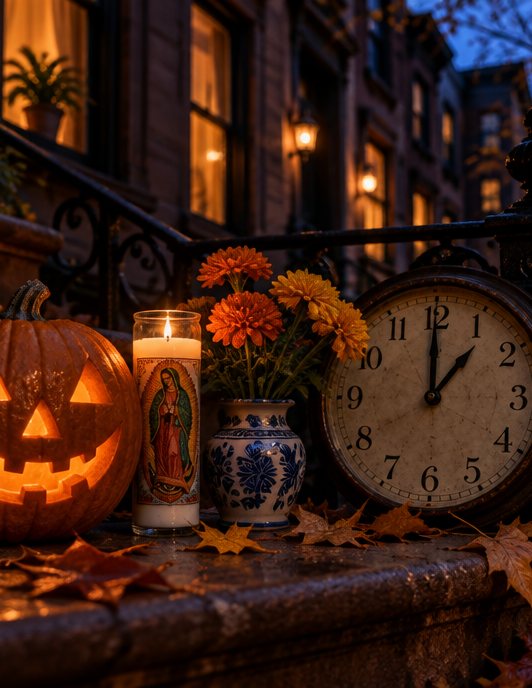
This year, Halloween got an extra hour. The costumes came out Saturday night, October 31, and at 2:00 a.m. on Sunday, November 1, the clocks across most of the United States slid back to 1:00 a.m. That made November 1 a 25-hour day, with the hour between one and two in the morning happening twice (Indian Eagle).
Think about where that hour landed. Somewhere between the last party and the first light of All Saints' Day, while vampires and Spider-Men were catching cabs home, time itself folded over. For a festival built on the idea that the line between worlds goes thin, that is almost too perfect.
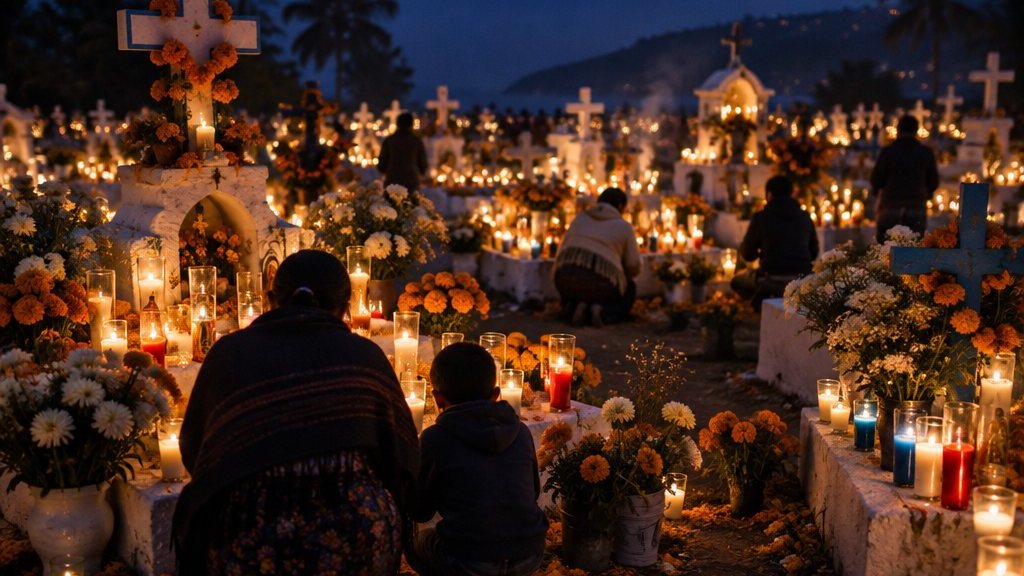
But Halloween was never just one night. It is the front door to a three-day stretch that much of the world spends with its dead. In Harlem it looks like candy and costumes. In Santo Domingo, Port-au-Prince, Mexico City and La Paz, it looks like cemeteries full of candles. This is the story of how those two things ended up sharing the same calendar, and why so many grown adults now treat October 31 like it belongs to them.
Where it comes from
Most historians trace Halloween back about 2,000 years to Samhain, a Celtic festival in what is now Ireland, the United Kingdom and northern France. It marked the end of the harvest and the start of the dark half of the year, a night when the dead were believed to cross back into the world of the living (Cleveland Stater; The Star). Scholars still argue about how direct the line is from Samhain to modern Halloween; the honest answer sits somewhere in the middle (Live Science).
When Christianity spread across Europe, the Church built its own holy days on top of the old calendar. In the eighth century, Pope Gregory III set November 1 as All Saints' Day, also called All Hallows. The night before became All Hallows' Eve, which got shortened over centuries to Hallowe'en (Cleveland Stater). Around the year 998, a Benedictine monk, Odilo of Cluny, fixed November 2 as the Day of the Faithful Departed, All Souls' Day (El Día).
Put together, that makes a three-day season called Hallowtide: the eve on October 31, the saints on November 1, and every other soul on November 2. In medieval Europe the poor went door to door on those nights, offering prayers for the dead in exchange for small "soul cakes" (Wiccan Rede). If that sounds like trick-or-treating, it should.
The custom crossed the Atlantic with Irish Catholics, especially after the potato famine pushed waves of families to America (GNA Insider). Here it shed most of its prayers and kept the masks, the bonfires turned into jack-o'-lanterns, and the soul cakes turned into fun-size candy bars.
What it means in Latin America
In Latin America, Halloween is the guest. The host was already there. Nearly every Indigenous culture in the region had some way of remembering the dead, often by sharing a meal at the grave, long before Spain arrived (Morgan Hill Times). When the Spanish brought Catholicism, they lined those observances up with All Saints' and All Souls' Days, so the old ways and the new calendar fused (Revista Mercado).
The result is a split that many Latino families still follow: November 1 belongs to the children who have died, the little ones or angelitos, and November 2 belongs to the adults (Uniclaretiana).
Mexico has Día de Muertos, with altars of photos, food, candles and marigolds. UNESCO added it to humanity's cultural heritage list in 2008 (El Dinero).
The Dominican Republic keeps Día de los Fieles Difuntos on November 2. Cemeteries get cleaned and painted, families bring flowers, velas and velones, and in some communities candles are lit in the street where someone died (El Dinero; El Nuevo Diario). Unlike Mexico's version, the Dominican day grows out of the Catholic calendar rather than a pre-Hispanic festival (El Día).
Paraguay, Argentina and Uruguay mark Todos los Santos at the cemetery: cleaning niches, lighting candles, handing out drinks and sweets to visitors (ABC Color).
Halloween itself arrived from the United States. By the late 20th century, costumes, carved pumpkins and trick-or-treating were common in Latin American cities, especially near the U.S. border (Post Register). Not everyone welcomed it. In Mexico, the line "Día de los Muertos is not Mexican Halloween" became a political statement in the 1990s, a way of defending national identity against American culture (PBS NewsHour).
Then the two started to blend anyway. By the early 2000s, anthropologists were documenting the fusion, and today Mexican kids trick-or-treat in costume for a full week of the Day of the Dead season (Religion News Service; Times Live). One night is for fantasy and fright. The next two are for memory and love. Most families now do both.
Around the world, the dead get their own days
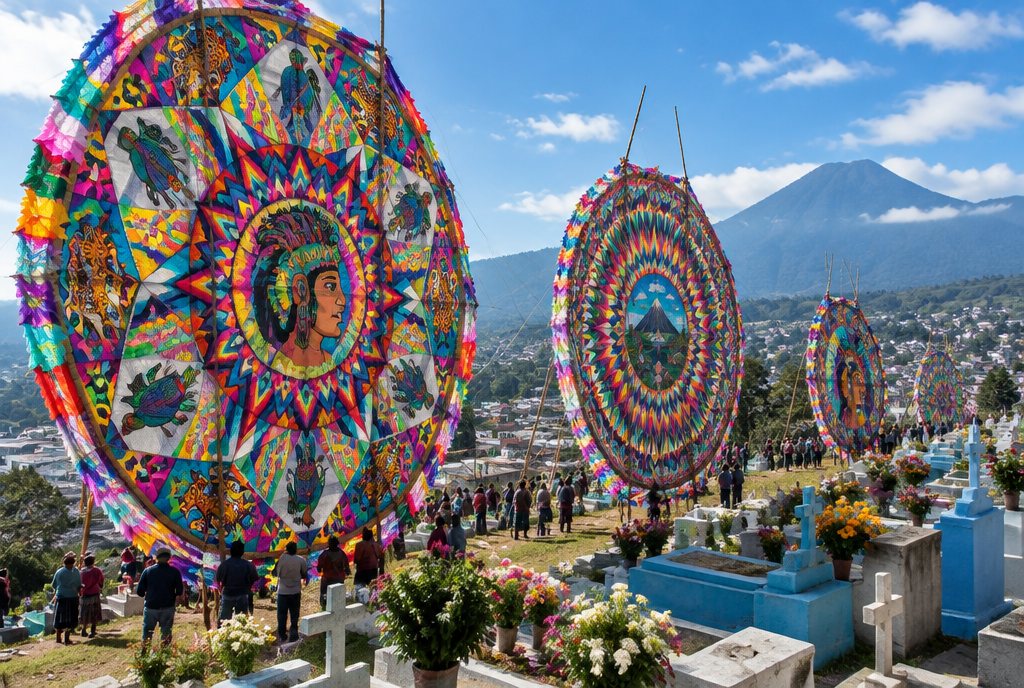
Step outside the American version and the same week shows up everywhere, wearing different clothes.
- Haiti, Fèt Gede (Nov. 1 and 2). Families converge on cemeteries to honor their ancestors, and the spirits of the dead, the Gede, are honored in black, white and purple. Practitioners often dress in white and paint their faces to represent them (Travel Noire; Africanews). In other words, the face paint came first.
- Guatemala, Barriletes Gigantes (Nov. 1). In Sumpango and Santiago Sacatepéquez, villagers fly enormous kites of bamboo and tissue paper over the cemeteries, some 17 to 19 meters across. Local legend says elders once told people to shake paper in the wind to chase evil spirits away from the good souls resting there (Prensa Libre).
- Bolivia, Día de las Ñatitas (Nov. 8). In La Paz, families decorate human skulls with flowers, hats and sunglasses and carry them to the General Cemetery with coca leaves and candles. Many believe their ñatitas protect the household (Holafly).
- The Philippines, Undas. Malls put up pumpkins, but the real event is families spending All Saints' Day together at the cemetery (Navi Manila).
- Portugal, Pão-por-Deus. Kids go door to door on November 1 asking for "bread for God," a custom some link to survivors of the 1755 Lisbon earthquake (Holafly).
The pattern is hard to miss. Wherever the harvest ends and the nights get long, people go looking for their dead.
The extra hour, and what it costs
The ancient Celts marked the dark half of the year with fire. Modern Americans mark it by changing the microwave clock. Daylight saving time ends on the first Sunday of November, and this year Europe had already turned its clocks back a week earlier, on October 25 (Karmactive). Clocks spring forward again on March 14, 2027.
The extra hour of sleep feels like a gift. The darkness that follows is not. A Danish study of 185,419 depression diagnoses between 1995 and 2012 found an 11 percent jump in new depressive episodes right after the switch to standard time, fading over about 10 weeks (Mental Floss). The researchers' theory: the hour gets taken from the evening, when people are out and about, and handed to the early morning, when most of us are in the shower or on the train. The switch also forces everyone to admit that months of long, cold nights are coming.
The effects reach the street too. Researchers have tied the extra evening darkness to more pedestrian deaths during rush hour (Capital News Service). Sleep experts compare the shift to mild jet lag: slower focus, weaker memory recall, lower alertness for a few days (CBS 58).
So the calendar lines up in a way that is easy to overlook. On the same weekend we dress as the things that scare us, the sun starts setting before most people leave work. Halloween might be the last big party before the season of getting through it.
When it stopped being about kids
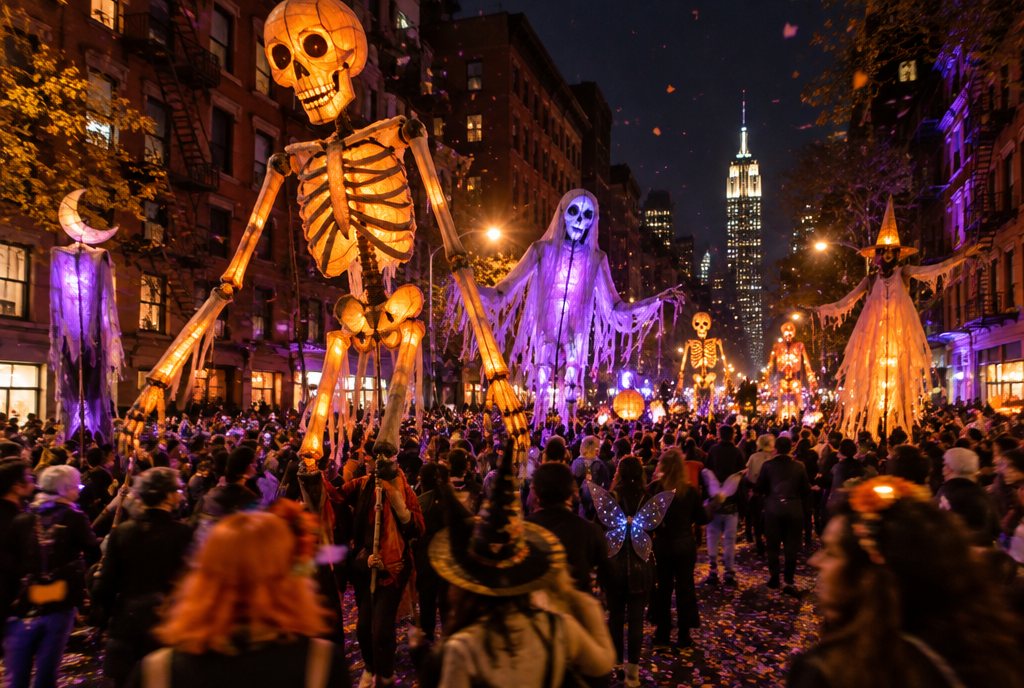
This year, American adults spent more on their own costumes than on their children's. The National Retail Federation projected $13.5 billion in total Halloween spending for 2026, with $4.4 billion on costumes: about $2 billion for adults, $1.5 billion for kids and $920 million for pets (NRF; Stacker). Seventy-four percent of people planned to celebrate, and the adults who dress up start shopping earliest, most of them by September (Haunted Attraction Network).
It wasn't always like this. Until the 1970s, Halloween in North America was largely a children's holiday. The big exception was queer communities in cities like New York, San Francisco and Toronto, who were already throwing adult Halloween celebrations (The Ryersonian).
The turn has a rough birthplace. In San Francisco's Castro neighborhood, a kids' street festival sponsored by a local store became, during the 1970s, an adult party of over-the-top costumes and theater (Dallas Voice). In New York, on October 31, 1974, Greenwich Village puppeteer and mask maker Ralph Lee led a small procession of puppets for children around the Westbeth artists' building (CultureNOW). New management soon added more adult elements, including a ball after the march (Wikipedia). That procession grew into the Village Halloween Parade, the largest Halloween parade in the world, with its roots in the city's queer community (Wikipedia).
Through the 1980s the street-party model spread to West Hollywood, Key West and beyond, and straight crowds started showing up to watch and then to join (PJ Media). Retail followed the crowd. By 2006, one costume merchant told the New York Times that the "sexy" versions made up 90 to 95 percent of its women's costumes (HuffPost). Survey numbers tell the same story: in 2005, about half of American adults said they planned to celebrate; by 2012 it was just over 70 percent (The National).
In other words, adults didn't take Halloween from kids. A community that needed a night to be fully itself built one, and everybody else eventually asked to come in.
Why grown folks dress up
So is the adult costume obsession just marketing? Partly. But psychologists keep landing on a few deeper reasons.
- A night off from yourself. Responsible adults spend all year managing the impulses they had as kids. A costume gives permission to drop that for a few hours (Money). Fashion psychologist Shakaila Forbes-Bell points to the anonymity: people with serious jobs or serious lives get to hide behind a costume and be someone else (Fashion Is Psychology).
- Showing what you usually hide. Psychologists argue that costumes reveal more than they conceal. People pick figures they admire, figures they want to mock, or dark characters that let them express a side they keep in check the rest of the year (The Villanovan). Nobody who waits tables dresses as a waiter.
- Making peace with fear. Dressing as the monster is a way to stand next to death, danger and taboo without paying the price. Laughing at what scares us is one of the oldest coping tools there is (Thriveworks).
- The trickster. Jungian psychology describes an archetype that breaks rules and flips order upside down. Evil clowns, witches and chaos characters all belong to that family (The National).
- Belonging. Group costumes and parties give adults a reason to talk to strangers, flirt, and bond with old friends (Money).
And in 2026 there's a new layer: the costume is content. Forty-seven percent of shoppers used AI tools to brainstorm costumes and decorations this year (Dallas Express), and the outfit lives on long after the party in photos and reels. The mask used to hide you from the spirits. Now it is how you get seen.
Is it something deeper?
Strip away the candy and the photo ops and Halloween still rests on one old belief: that at certain times, the dead are close. The Celts called it the thinning of the veil. The Church gave it saints and souls. For a lot of people in the Caribbean and Latin America, though, that closeness was never limited to one week.
In the African diaspora religions that took root in the Americas, ancestors are not a seasonal theme. They are part of daily spiritual life. In Lucumí, the tradition most people know as Santería, the spirits of the dead are called egun, a Yoruba word associated with "bones," and they include blood relatives and spiritual elders alike (Original Botanica). For practitioners, the border between the living and the dead does not wait for October (Pluralism Project).
In the Dominican Republic, Las 21 Divisiones, often called Dominican Vudú, is a heavily Catholicized tradition that grew out of the colonial island's African and Caribbean roots (Wikipedia). Its connection to this season shows up in a figure many Dominicans know even outside the practice: the barón del cementerio. In popular belief, the first person ever buried in a cemetery becomes its barón or baronesa, and people bring offerings and light candles at that grave asking for favors (Acento). Across the border in Haiti, Bawon Samdi stands as guardian of the cemetery and head of the Gede during Fèt Gede (M.J. Fievre).
These traditions are private, specific and lived, and they deserve more than a paragraph in a Halloween story. The point here is narrower. Long before American stores sold skeleton suits, people across these islands were painting their faces, visiting the dead and asking the other side for help. Masquerade in its oldest sense, from the Egungun festivals of Nigeria to carnival traditions in Trinidad and New Orleans, was a way of honoring ancestors, not a way of joking about them (Love Black Girls).
So when an adult in Harlem puts on a mask on October 31, they may be doing something older than they realize. The difference is whether they know who they are dressing up for.
The secret beliefs
Under the public holiday there has always been a private one: small rituals people did at home, quietly, because these nights were believed to open doors that stay shut the rest of the year.
In Ireland, it was the night to see the future. Halloween was prime time for divination, mostly about love and death (RTÉ Brainstorm):
- A long apple peel tossed over the shoulder was read as the first letter of a future spouse's name.
- Hazelnuts named for a couple were set in the fire. If they burned quietly side by side, the match was good; if they jumped apart, it wasn't.
- Iron, a cabbage leaf or yarrow under the pillow was supposed to bring your future spouse into your dreams.
- A blindfolded person picked one of several saucers: water meant a sea voyage, salt meant money, a ring meant marriage, and clay meant death.
The barmbrack, a fruit bread still sold in Ireland every October, carried the game into the kitchen. Charms were baked inside: a ring for marriage within the year, a pea for poverty, a button for staying single, a rag for hard times (RTÉ Brainstorm). Some older spells went much darker, including love charms that called on the devil, recorded by folklorist Lady Jane Wilde.
In Mexico, it is the night you stay inside. In Yucatán, folk belief says the souls arrive around midnight on October 31 in a procession, dressed in white and carrying candles. If one hands you its candle, it turns to bone by morning and brings a serious illness. Families keep the house clean so the visiting dead don't feel obliged to tidy up, and children wear a red thread so the souls don't take them (Diario de Yucatán). Another rule: no photo or favorite food on the altar for someone who died less than a year ago, because the soul may not yet know it has passed.
In the Andes, it is the night you light the road. In rural Ecuador, families put a candle on every grave the evening before Día de los Difuntos so returning souls can find their way. People there say they feel the dead when a door shuts on its own or the wind suddenly stops (Extra).
In the Dominican countryside, the dead can still do favors. Some rural Dominicans believe a dead person can lead you to buried treasure, a botija, or hand you a lottery number in a dream. The ánimas get called on for rain, and the richest folk life around the dead happens at velorios, cabos de vela and novenarios (Acento).
The details change from country to country. The core belief does not: for a few nights, the dead are listening, so watch what you do.
What religion says about it
No major faith officially celebrates Halloween as it looks today. The Church that named it wants the focus back on the saints, and many other traditions keep their distance for the same reason: the night is tied to spirits, divination and the occult. Only modern pagans claim the old festival as fully their own.
- Catholic Church: Wary; points families toward All Saints' Day. In 2009 the Vatican newspaper L'Osservatore Romano warned that the holiday carries an undercurrent of occultism (Fox News). Some French Catholics say it pulls attention from All Saints' Day (NPR). Since 2002, "Holywins" events have kids dress as saints instead, spreading from Paris to Spain, Poland and Latin America (Catholic Review).
- Lutheran and Reformed Protestants: October 31 is Reformation Day. Martin Luther posted his 95 Theses in Wittenberg on October 31, 1517; many churches mark that instead (Christianity.com).
- Some evangelical churches: Avoid it; hold fall festivals or "trunk or treat." They see the holiday as pagan and tied to devil worship (Romper).
- Jehovah's Witnesses: Do not celebrate. They link it to the occult and cite Deuteronomy 18:10-12, which condemns divination and consulting spirits (JW.org).
- Russian Orthodox: Many reject it. Seen as going against Christian values (Romper).
- Orthodox Judaism: Generally avoids it. Leviticus 18:3 is read as a ban on adopting non-Jewish religious customs; some families allow kosher candy (Wikipedia).
- Reform Judaism: Up to the family. The Union for Reform Judaism calls it a matter of informed choice. Purim, with its costumes and gift baskets, is sometimes called the "Jewish Halloween" (Wikipedia).
- Islam (many scholars): Discouraged. Islam recognizes two holidays, the two Eids; scholars cite pagan origins, links to magic, and waste (IslamOnline; Romper).
- Latter-day Saints: Family decides. Many shift festivities when Halloween falls on a Sunday (Romper).
- Wicca and modern paganism: A sacred night. Samhain is "the witches' New Year," a time to release the past year and honor the dead, sometimes in a "circle of the dead" (Spokesman-Review).
That leaves Latino families in an interesting spot. A household can have a grandmother lighting velones for the ánimas, a cousin at an evangelical church that won't let the kids trick-or-treat, and teenagers who just want the party. All three are reacting to the same old idea: that the dead are near.
Other thoughts
America sells death; Latin America sits with it. U.S. Halloween keeps death at a safe distance, turning it into a joke, a costume, a 12-foot skeleton in the yard. Much of Latin America does the opposite. It cleans the grave, cooks the dead person's favorite dish and talks to them. One culture uses the night to laugh at mortality. The other uses it to stay in relationship with the people it took.
The fear is the same; only the answer changed. The divination games, the red thread, the stay-inside rules and the church warnings all come from one instinct: something is out there on these nights. The old answer was ritual. The modern answer is a costume and a party. Both are ways of managing the dark.
Religion and Halloween agree on more than they think. The Vatican, the Jehovah's Witnesses and modern witches would describe the night in almost the same words: a time when the spirit world comes close. They only disagree on whether to open the door.
Grown-ups needed it more than kids did. Children have play every day. Adults rarely get permission to be someone else, to be scared on purpose, or to say out loud that they miss the dead. Halloween hands them all three for one night, right as the clocks take away the light.
What gets lost in translation. As Halloween keeps spreading across Latin America, the risk isn't the candy. It's that the next generation keeps the costume and forgets the cemetery. The healthiest version may be the one many families already live: dress up on the 31st, then show up for the dead on the 1st and 2nd.
The morning after
By the time most people read this, the costumes are in a pile on the floor and the clock on the stove is finally right. Today is All Saints' Day. Tomorrow, in cemeteries from Santo Domingo to Port-au-Prince to Mexico City, families will sweep graves, light velones and say names out loud.
That is the part of Halloween the U.S. mostly forgot to bring over. The costume was never the point. It was the doorway. October 31 is the night we play with death; November 1 and 2 are the days we sit with it.
Maybe that is why adults hold on to this holiday so tightly. The days are getting shorter, the clocks just stole our evenings, and somewhere under the fake blood is an old instinct that knows this is the season to remember who came before us. We got an extra hour this year. Spend some of it on them.
Your turn
How does your family split the weekend: costumes on the 31st, cemetery on the 1st and 2nd, or both at once? Tell us below.
Sources: National Retail Federation 2026 Halloween survey; RTÉ Brainstorm; Diario de Yucatán; Extra (Ecuador); Acento; El Día; El Dinero; El Nuevo Diario; PBS NewsHour; Religion News Service; Prensa Libre; Travel Noire; Holafly; Mental Floss; Dallas Voice; CultureNOW; The National; Money; Pluralism Project; Original Botanica; Fox News; NPR; Catholic Review; Christianity.com; JW.org; Romper; IslamOnline; Spokesman-Review.
Images are AI-generated illustrations created for this story.
For us. By us. Follow @theinnovatorsden.