The Sword, the Storm, and the Prayer
Who is like God? On September 29, an archangel, an island, and the prayers that carried us.
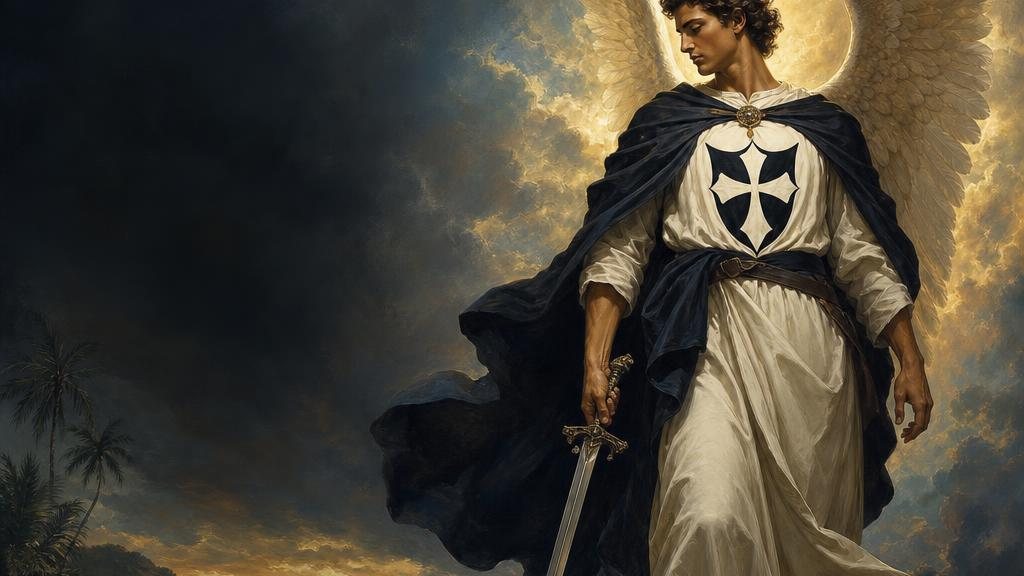
Mi-ka-El.
Three syllables in Hebrew, and a whole theology folded inside them. Mi means who. Ka means like. El means God. Who is like God?
Read it again slowly, because the first thing to notice is that his name is not an answer. It is a question. The most famous warrior in the unseen world carries a name that asks something, and the question is a humbling one. It is a question wearing armor.
On September 29, the Church honors him. Across Dominican homes, candles are lit for San Miguel. And in the tradition of the 21 Divisions, many people honor Belié Belcán beside him. This story is about all of that: the name, the sword, the storm, the prayer, and the island where faith learned to speak with an accent.
The name
Names in scripture are rarely decoration. They are job descriptions.
Gabriel is "God is my strength," and he arrives carrying messages. Raphael is "God heals," and in the book of Tobit he walks a young man down a road and mends his father's eyes. Michael is "Who is like God?" and he arrives carrying nothing but the question, and the willingness to stand behind it.
That is worth sitting with. The greatest of the angelic warriors does not introduce himself by boasting about his own strength. His whole identity points away from himself. Every time his name is spoken, it is a reminder of who the throne belongs to, and that nothing, and no one, is its equal.
In scripture
The Bible names Michael five times. Three in the book of Daniel, once in the letter of Jude, and once in Revelation.
In Daniel, he appears as a great prince and a protector of Daniel's people, the one who comes to help when a messenger is delayed in the unseen world, and the one who "shall stand up" in a time of distress such as never was. In Jude, he is the archangel disputing with the devil over the body of Moses, and even there he refuses to speak in his own authority, saying only, "The Lord rebuke you." In Revelation, he leads the armies of heaven in a war against the dragon.
Read those five appearances together and a pattern shows up. Michael is never present when life is comfortable. He does not turn up at a banquet. He shows up when history shakes: when a people is threatened, when a body is contested, when the sky itself is at war. And in every scene, he fights without claiming the glory. The question in his name is the posture of his whole life.
Across faiths
He is one of the rare figures who is recognized across three of the world's great traditions, in different portraits.
In Jewish tradition, he is the defender, the prince of Israel, the angel who stands up for the people when they are in danger.
In Christianity, he is the dragon slayer. The image most of us know, the sword raised over a defeated serpent, comes from Revelation and from centuries of sacred art. He is also traditionally pictured with scales, weighing souls, and standing at the side of the dying.
In Islam, he is Mīkā'īl, one of the great angels, named in the Quran and associated in tradition with rain and provision, the angel who helps sustain life on earth. This is the storm in our title, and notice what it changes: the same figure who is a warrior in one tradition is a bringer of water in another. A sword and a rainstorm, held by one name.
Three portraits, and one rule that holds in all of them: the angel never takes the place of God. Michael's power is borrowed. His whole meaning is that he points beyond himself.
On this day
September 29 is the feast, and it is a little more complicated than people expect.
In the Catholic Church, September 29 honors Michael, Gabriel and Raphael together. Anglicans keep the day as Michael and All Angels. The Orthodox churches celebrate the Synaxis of the Archangels on November 8, so their feast lands about six weeks later. Same company of angels, a different date on the calendar.
For many families, though, the day is not abstract. It is a day for a candle, a prayer, a conversation with grandparents, a plate set out. It is the kind of devotion that lives in kitchens and in front rooms long before it lives in a textbook.
In the 21 Divisions
Now the story crosses an ocean.
In Dominican Vodú, the tradition often called the 21 Divisions, many people honor Belié Belcán beside San Miguel. Celebrations are held on September 29 or the night before, because in so many traditions the vigil is part of the feast.
It is important to say this carefully, and to say it in the right order. This is a living religious practice, and it belongs to the people who practice it. What we can offer is respect, curiosity, and the plain description of how it is lived: that for many Dominicans, the figure of the archangel and the figure of Belié Belcán are honored together, and that the sword and the protection associated with Michael resonate with what these communities seek from Belié Belcán.
Two rivers
So are they the same? Here is where we stay honest.
The Church does not teach that they are one. Catholic teaching does not identify Michael the Archangel with a spirit of Vodú, and it would be careless to pretend otherwise. And Vodú is not simply Catholicism wearing a costume.
But protection recognizes protection.
Think of two rivers that meet at a confluence. They flow side by side, they share a bed for a while, and the water mixes where they touch. Yet they do not share a source. Each began in its own mountains, carrying its own history. That is a better picture than the idea that one river secretly is the other. Two traditions can meet without dissolving into each other, and the meeting can still be real and meaningful to the people who stand in the middle of it.
Survival
How did the meeting happen? The answer is not gentle.
When Africans were enslaved and brought to Hispaniola, they carried their spiritual worlds with them, because those worlds could not be taken from the mind. They arrived in a colony ruled by Spain, where Catholicism was the official faith and the saints were everywhere: painted on walls, carried through streets, named in every prayer. And so the old practices and the new images began to speak to each other.
Some of that was disguise. A figure could be honored in public as a saint while remaining something more in private. But reducing it only to disguise misses the deeper truth. Syncretism was also translation. It was a way to carry one language of the sacred into another, so that meaning did not die in the crossing. It was memory, and it was survival.
That is why we say this is an island where even faith learned to speak with an accent. The Dominican way of praying is not a diluted version of something purer somewhere else. It is the sound of many peoples, Taíno, African and Spanish, having to find words for the same hunger: to be protected, and to be heard.
The real weapon
So what, finally, is the sword for?
Strip away the painting and the armor, and look at what Michael is asked to fight. In every era the throne is reached for by the same four hands. Money reaches for it, promising security. Power reaches for it, promising order. Fear reaches for it, promising safety if only we would obey. And the past reaches for it, insisting that what we have always done is what we must always do.
Each of them wants to be treated as if it were final, and to be obeyed as if it could not be questioned.
And here is the quiet genius of the archangel's name. Michael does not need a speech for any of them. His name answers each one in turn. Who is like God? Not money. Who is like God? Not power. Who is like God? Not fear, and not the past.
No one.
That is the real weapon. Not the blade in the painting, but the question that cuts every false throne down to size.
Thank you, San Miguel
We wrote this on a day when many of us are thinking about the people we love, and the seasons we have been carried through.
So here is our own small prayer, in the spirit of the one this day invites: Thank you, San Miguel. Keep our families protected, our purpose clean and our hearts humble.
Your turn
What prayer carried you through your hardest season? A line from a grandmother, a psalm, a whispered word in a hospital hallway, something older that no one wrote down. Share it in the comments. Someone reading may need it today.
Follow @theinnovatorsden. Save this and send it to someone who lights a candle on September 29.
For us. By us.
Hashtags: #SanMiguelArcangel #SaintMichael #BelieBelcan #21Divisiones #DominicanCulture #Dominicana #AfroCaribbean #Faith #September29 #TheInnovatorsDen