Nowhere to Stop: Living in New York in 2026
A New Yorker pays more to live here, more to drive here, and more to stand still for two minutes at the curb, while the streets show a city still struggling with drugs and homelessness.
October 28, 2026
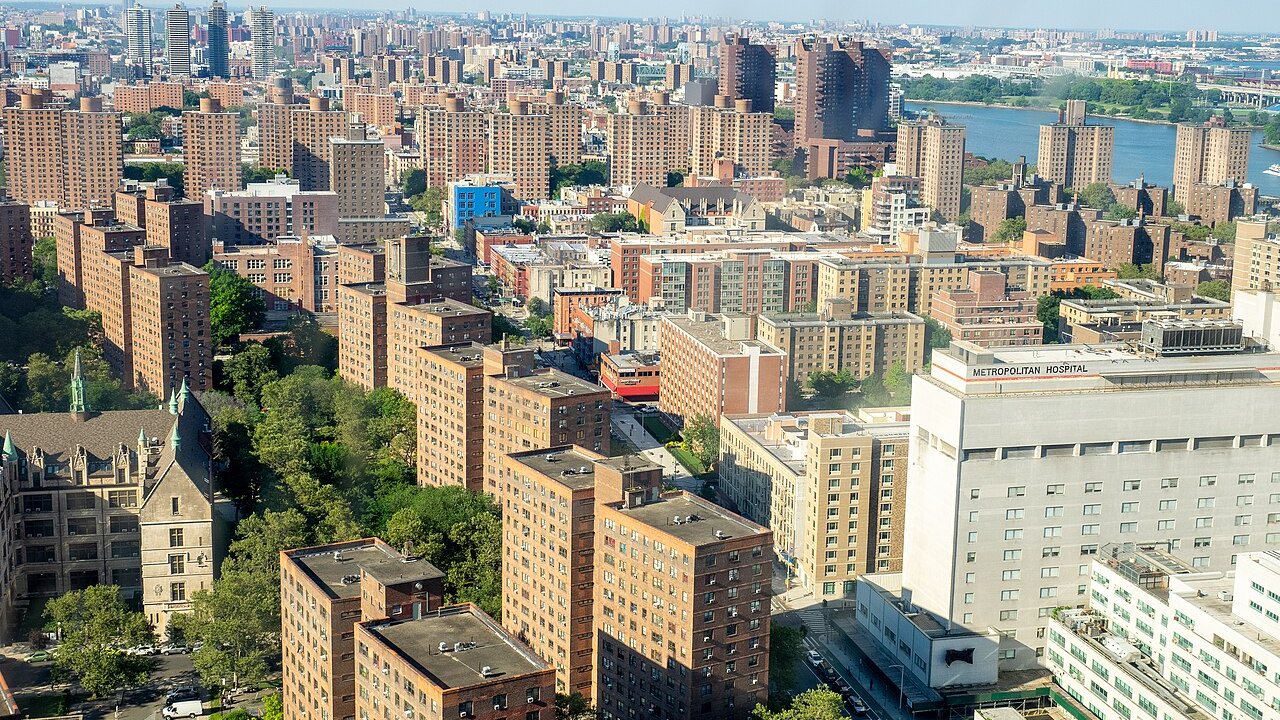
Photo: East Harlem by Ajay Suresh, CC BY 2.0, via Wikimedia Commons.
Two minutes at the curb
It is 7:40 on a Tuesday night when Marisol turns onto her block in East Harlem with six bags of groceries, a case of water and a 9-year-old asleep in the back seat.
There is no open spot. There has not been an open spot on this block since spring. She does what New Yorkers have done for decades: she flips on the hazards, double-parks, and starts hauling bags up four flights.
When she comes back down, a city bus is easing around her car. She does not know yet that the camera on its windshield has already taken her picture. The ticket will come in the mail.
"I'm not parking," she says. "I'm carrying milk upstairs. Where am I supposed to put the car for two minutes?"
That question, asked in some version on every block in the five boroughs, is where this story starts. It does not end at the curb.
Marisol is a composite, built from what New Yorkers told News 12, NY1, PIX11 and FOX 5 this year. Every number around her is real.
The curb is shrinking
The street in front of Marisol's building is being asked to do more jobs than ever: carry buses, bikes, delivery vans and Ubers, and still store about 3 million parked cars for free. Only about 80,000 of the city's on-street spaces are metered.
Every redesign takes a piece of that curb back.
East Harlem, 116th Street. Construction is underway on 2.5 miles of bus lanes, protected bike lanes and new pedestrian space for a corridor that carries more than 65,000 daily bus riders on ten routes. To make room, the city is repurposing 61 parking spaces and removing the wide shared parking-and-travel lanes. One reader under the announcement summed up the local mood: "These bus and bike lanes bring traffic to a halt."
The Bronx, University Avenue. A new bus lane toward Kingsbridge Road was criticized for wiping out close to 300 residential spaces. Residents told News 12 it already took 45 minutes to two hours to find a spot, and some said their cars were towed without notice. "If they're taking it away, give us something else to use, give us a parking lot or something like that," said resident Glen Bracey. DOT answered that the lanes speed commutes for 55,000 weekday riders.
Manhattan, 72nd Street. In April, DOT unveiled a plan to cut the street from four travel lanes to two, with a two-way protected bike lane and bus boarding islands. Merchants packed the community board meeting to object.
The next fight is over whether parking stays free at all. On March 5, First Deputy Mayor Dean Fuleihan said charging for currently free street parking was "not a no" as City Hall faced a $5.4 billion budget gap. Advocates at the Center for an Urban Future estimate that metering a quarter of free spaces could raise $1.3 billion a year. Mayor Zohran Mamdani distanced himself: "You do not fill a $5.4 billion budget gap through parking meters." Meanwhile, bills for residential parking permits in Northern Manhattan and Kew Gardens are back before the City Council.
What almost nobody has been given is a legal place to stop for two minutes. DOT's own data says loading zones cut double-parking by up to 70 percent, yet the Upper East Side has just 34 zones set aside for residential deliveries and drop-offs. Doormen there have started putting out their own traffic cones.
The bus that writes tickets
Marisol's ticket came from the MTA's Automated Camera Enforcement program, known as ACE. Since June 2024, cameras mounted on buses have ticketed drivers who sit in bus lanes, block bus stops or double-park anywhere along a camera route. By June 2026 the program covered 62 routes. Fines start at $50 and climb to $250 for repeat offenders.
In the city's fiscal year that ended June 30, 2026, the bus cameras' new powers produced more than 1.1 million tickets for double-parking and blocking bus stops alone.
Camera violations, FY26 (July 2025 to June 2026): tickets issued and fines issued
- Bus lane (fixed cameras): 713,492 tickets, $59.9M
- MTA bus camera, double parking: 565,167 tickets, $60.0M
- MTA bus camera, blocking a bus stop: 550,933 tickets, $56.3M
- MTA bus camera, bus lane: 231,680 tickets, $26.3M
Those are a slice of a much bigger bill. The city issued 15.8 million parking tickets and camera violations in FY26, worth $1.15 billion, and collected $979 million. Passenger cars, not delivery trucks, got 82 percent of them.
Fighting one is a long shot. Of the 1,410 MTA double-parking tickets drivers appealed after losing a hearing, 48 were thrown out.
1,410 drivers appealed a bus-camera double-parking ticket. 48 won.
On a Park Slope corner, a driver named Woodies told NY1 what the rule feels like from behind the wheel: "You gonna have to double-park if you got delivery people that's gonna come or somebody that's going into a business... real quick stuff." Then she added: "I got $200 in tickets in my car right now."
Riders see the same car differently. "It's that one double-parked car that you can see," said Danny Pearlstein of the Riders Alliance, "and the fact is that that one double-parked car all too often, that's ruining bus service for 40 or 50 people on a bus."
The MTA says the cameras work: buses on ACE routes run about 5 percent faster on average and up to 30 percent faster on some stretches, with 20 percent fewer collisions. On the Bronx's Bx36, bus-stop tickets fell from 4,905 in September 2024 to 754 in November 2025, an 85 percent drop.
Drivers learned. The question is what they were supposed to do instead.
Paying to enter, paying to stop
If Marisol drives downtown for work, the bill starts before she parks. Since January 5, 2025, most drivers pay a $9 congestion toll to enter Manhattan at or below 60th Street during peak hours.
The toll did what it was designed to do. In its first year, 27 million fewer vehicles entered the zone, about 73,000 fewer a day, and traffic fell 11 percent. It raised about $550 million for the MTA, backing $15 billion in transit bonds. A Cornell study found fine-particle air pollution in the zone fell 22 percent in the first six months.
But it is still a charge that lands hardest on people who feel they have no other way in: the home health aide on an early shift, the contractor with tools in the trunk, the parent from the Bronx with a doctor's appointment in Midtown. U.S. Transportation Secretary Sean Duffy put that argument in writing, saying the toll "takes more money from working people to pay for a transit system and not highways." On March 3, 2026, federal Judge Lewis Liman ruled the Trump administration's attempt to kill the toll unlawful. Suits from New Jersey and the Trucking Association of New York are still pending, and under federal law the toll is set to rise in 2028 and again in 2031.
Then comes the parking itself.
Garages. Monthly parking in Manhattan's busier neighborhoods typically starts around $500. Near Central Park or in Lower Manhattan, listings reach $1,400 a month, and Upper East and West Side rates can hit four digits. That is close to the $1,526 a renter pays for a typical one-bedroom apartment nationally, according to Zumper.
Fewer garages. Many lots have been sold off for apartments. By 2017, PropertyShark counted 190 Manhattan parking facilities closed and redeveloped in a decade, and new buildings are not required to replace them.
Meters. Meter rates rose citywide in 2018 for the first time since 2011, reaching $7.50 an hour in Midtown after the first hour.
For Marisol, the math is simple. The street is free but full. The garage has room but costs as much as an apartment in another city. The double-park is the only option she can afford, and now it comes with a camera.
The rent
Upstairs, the groceries go into an apartment that costs more every year to keep. In June 2026, Manhattan's median market-rate rent hit a record $5,295 a month, up 8 percent in a year, according to Corcoran. Brooklyn set its own record at $4,350.
The steepest climb was at the bottom of the market. The median for non-doorman apartments, a stand-in for the cheaper half of Manhattan, rose 18 percent in a year to $4,695. Fewer than 2 of every 100 Manhattan apartments were vacant in May, and listings were down 16 percent from a year earlier. "Manhattan renters are chasing a shrinking pool of available apartments, and the result has become predictable: record rents," said Corcoran's Gary Malin.
Across the Hudson, the picture is different. Zumper put Jersey City's median one-bedroom at $2,860 in May, down 2.1 percent from a year earlier, against a record $4,680 in Manhattan.
There was relief for some. On June 25, the Rent Guidelines Board voted 7 to 1 to freeze rents on one- and two-year leases for about 1 million rent-stabilized apartments, home to roughly 2.4 million New Yorkers, for leases starting October 1, 2026 through September 30, 2027. It was the first freeze ever on two-year leases and a signature promise of Mayor Mamdani.
Landlords say the bill will come due somewhere else. The board's own research found operating costs for stabilized buildings rose 5.3 percent this year. "The Rent Guidelines Board ignored its own data and made a terrible decision tonight," said James Whelan of the Real Estate Board of New York. Board member Arpit Gupta, the lone no vote, pointed out that more than 57,000 stabilized units sat vacant last year, up from about 49,000 in 2024.
And the freeze does nothing for the New Yorker in a market-rate unit, whose lease renewal is set by the market, not the board.
What the sidewalk shows
When Marisol walks her daughter to school down Lexington Avenue, the trip passes through one of the hardest stretches in the city.
Residents along Lexington from 116th to 126th Street have described people smoking K2, injecting drugs and passing out on the sidewalk, sometimes in front of store entrances. "It really isn't safe," one resident told FOX 5, "especially if you've got people that are not using drugs at all." Another man told PIX11 what changed for the older neighbors: "Older people used to come outside and sit down in the cafe during the day. Drink a little coffee or something. Nobody wants to be out here no more."
Harlem residents have long argued that their neighborhood carries more than its share of the city's addiction programs, and the open-air market that follows them.
The citywide numbers are better than they were, and still grim. Overdose deaths fell 28 percent in 2024, from 3,056 to 2,192, according to the city Health Department. That is still about one death every four hours. Provisional counts for 2025 show 441 deaths in the first quarter and 456 in the third, with opioids involved in about 78 percent. "Overdose continues to be a public health emergency," the department says.
Homelessness is the other thing no one on Marisol's block can miss.
In shelter: 87,442 people slept in the city's main shelter system on an average night in May 2026, including 28,791 children, according to the Coalition for the Homeless. The State Comptroller counts about 140,000 homeless New Yorkers in all city systems, up 78 percent since 2019.
On the street: The city's 2026 HOPE count estimated 4,991 people sleeping outside or in the subways on March 10, up 11 percent from 4,504 a year earlier. People on the street rose 64 percent, while those in the subways fell 39 percent.
There is a catch in that last number. The count was pushed from January to March by a historic freeze, and it ran on a 59-degree night, 15 degrees warmer than any count in the past decade. "These numbers are a floor, not a ceiling," said Dave Giffen of the Coalition for the Homeless. During the February deep freeze, more than a dozen people died of hypothermia.
There is also some good news buried in the data. Drug-related deaths among homeless New Yorkers fell 28 percent in a year, from 348 to 251, as the city handed out 20,000 naloxone kits in its shelters.
Street homelessness reached a 10-year high in 2026. 4,991 people were sleeping outside or in the subways on one night, up 79% from 2016.
- 2016: 2,794
- 2017: 3,892
- 2018: 3,675
- 2019: 3,588
- 2020: 3,857
- 2021: 2,376
- 2022: 3,439
- 2023: 4,042
- 2024: 4,140
- 2025: 4,504
- 2026: 4,991
2026 was counted in March on a 59°F night; other years in winter. 2021 and 2022 ran under pandemic rules. Source: NYC Department of Social Services, HOPE estimates 2016 to 2026.
What New Yorkers are saying
Ask New Yorkers how it feels, and the answer is close to unanimous: it costs too much, and it is getting harder.
- Honan Strategy Group (June 2026): 63% say NYC is no longer the world's greatest city; 55% are dissatisfied with their quality of life; 50% say life feels worse than a year ago.
- Marist, as reported by the New York Post (February 2026): 86% say New York is not affordable for an average family; 33% plan to leave the state within five years, most often over cost of living (40%) and quality of life (21%).
- Citizens Budget Commission (2025): 34% rate their quality of life good or excellent, down from 51% in 2017; 1 in 4 rate it poor.
And people are acting on it. In April, the Citizens Budget Commission reported that New York City lost 114,000 more residents to the rest of the country than it gained, with more people leaving than arriving at every income level.
Half of the Honan poll's respondents named cost of living and affordability as the city's biggest challenge, well above crime and schools. Marisol would put it more simply. "Everything is a fee now," she says. "The rent, the toll, the meter, the ticket. I work two jobs to pay the city for standing still."
The other side of the ledger
The people who redesigned the street have numbers of their own, and they are not small.
Faster, safer buses. ACE routes now serve more than a million riders, and the MTA reports buses up to 30 percent faster on some stretches with 20 percent fewer collisions. Bus lanes on Lexington Avenue sped buses 19 percent and cut traffic injuries 24 percent, which is why DOT used them as the model for 116th Street.
Safer streets. DOT says streets with protected bike lanes see 39 percent fewer crashes that kill or seriously injure seniors. A year into congestion pricing, citywide traffic deaths were down 19.8 percent.
Less traffic, cleaner air. The Regional Plan Association found time lost to traffic jams in the Bronx fell 17 percent after the toll began, easing fears that drivers would detour through the borough. "People with asthma are breathing better," Governor Kathy Hochul said.
Money for transit. Toll revenue now backs $15 billion in subway and bus projects.
To transit advocates, the old curb was the real unfairness: a few cars stored for free while a bus full of 40 or 50 people waits behind them. "For too long, the health of our bus and bike lanes has been neglected," Mayor Mamdani said in February, as he revived street projects his predecessor had shelved.
Both things can be true. The bus is faster. And the woman with the groceries still has nowhere to stop.
Still here
The envelope arrives nine days later: $50, MTA double parking, a grainy photo of her own hazard lights blinking in the dark.
Marisol pays it online, on her lunch break, between a rent reminder and a text from her landlord about a lease renewal. She has thought about leaving. Her sister moved to Allentown last year and sends pictures of a driveway.
But her mother is on 118th Street, her daughter's school is three blocks away, and the bodega guy has known her since she was twelve. New York is still the place where her whole life fits within walking distance. It is just getting harder to carry the groceries up.
On the way home that night, she circles the block four times. On the fifth, a spot opens up. She takes it and sits in the car for a minute with the engine off, not getting out, just enjoying the one thing in this city that was free tonight.
Sources
Streets, parking and cameras: NYC Department of Finance, Parking Tickets and Camera Violations FY2026 (Local Law 6 report); MTA, ACE fines begin on B15 and M31 (June 2026); NY1, MTA continues crackdown with more cameras (Jan 2026); News 12, ACE expands to Bx9, Bx15, B11, B63 (Nov 2025); Streetsblog NYC: ACE bus stops (Jan 2026), 72nd Street (Apr 2026), Fuleihan on street parking (Mar 2026), Mamdani restores redesigns (Feb 2026), Upper East Side loading zones (Oct 2026), 2018 meter rates; New York YIMBY, 116th Street bus lane overhaul; News 12, University Avenue bus lane; Time Out New York; WABC Radio; Secret NYC.
Congestion toll and garages: New York Daily News via ArcaMax, congestion pricing by the numbers (Jan 2026); ABC7, one year later; News 12, first anniversary; Streetsblog NYC and Regional Plan Association, traffic jams in the Bronx and NJ; Washington Examiner, ruling (Mar 2026); NJBIA; CBS New York; Way.com, Manhattan monthly parking; NY1, Manhattan garages disappearing (2017); Zumper National Rent Report.
Rent: 6sqft and Brick Underground, Corcoran June 2026 report; Hoodline, May vacancy; Fox Business, Zumper Manhattan vs Jersey City; NY1, amNY, Bloomberg via Insurance Journal and Queens Chronicle, Rent Guidelines Board vote (June 2026).
Drugs and homelessness: NYC Health Department, Epi Data Brief 150 and provisional overdose reports Q1 and Q3 2025; FOX 5 NY and PIX11, East Harlem residents; NYC Department of Social Services, HOPE 2026 results; Coalition for the Homeless, shelter census and HOPE statement; NYS Comptroller (Mar 2026); PIX11; amNY.
Polls: Honan Strategy Group (June 2026); Marist (Feb 2026, as reported by the New York Post); Citizens Budget Commission survey (2025) and migration study (Apr 2026).